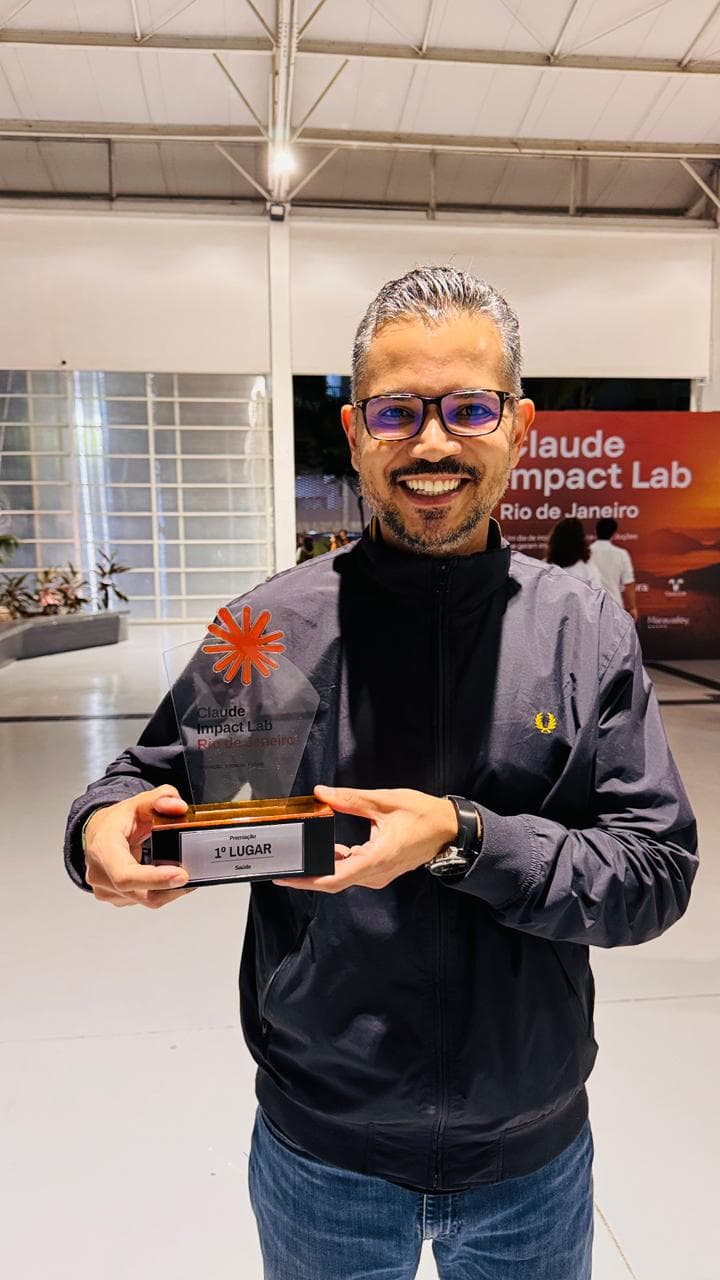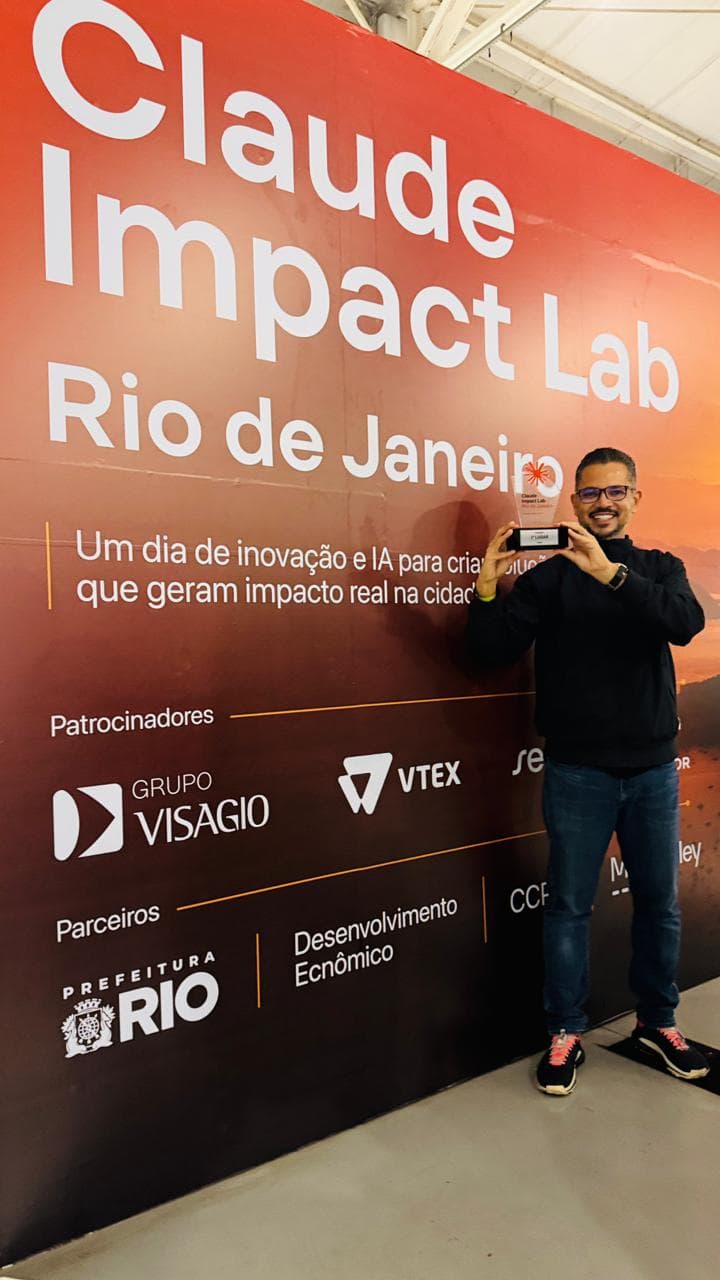
On May 24, 2026, Porto Maravalley — an innovation hub in Rio de Janeiro’s port district — hosted the first Brazilian edition of the Claude Impact Lab. The international hackathon program, run by Anthropic, brought multidisciplinary teams together to build, in a single day, artificial-intelligence solutions for two of Brazil’s largest urban challenges: public health and public safety.
Leonardo Santos, an AI and solutions consultant within Capiva’s ecosystem of strategic partners, took part as a member of a multidisciplinary team of five — medicine, product, AI, and engineering. The team took first place in the Health track with a solution that rethinks the work of Rio de Janeiro’s Community Health Agents around a non-negotiable principle: auditable AI, never autonomous in a clinical decision.
Auditable AI is the design in which generative AI accelerates building the tool, while the decision that affects a citizen is made by transparent rules, anchored in official sources and always reviewable by a human being in charge. The Claude Impact Lab is a global Anthropic program that brings free AI hackathons to cities around the world, with no prior programming experience required.
What is the Claude Impact Lab?
The Claude Impact Lab is a global Anthropic program that brings AI hackathons to cities around the world. Before Rio, the program had already run in San Diego, Miami, Santiago, and Mexico City. The format is deliberately inclusive: participation is free and requires no prior experience in programming or artificial intelligence. Teams bring together professionals from technology, design, business, communications, and public policy. The premise is that AI solutions for cities need diverse perspectives, not only engineers.
The Rio edition was organized by João Lisboa, Claude Community Ambassador in Brazil and co-founder of Taicor, in partnership with the City of Rio de Janeiro, Maravalley, the Municipal Secretariat for Economic Development, and other city agencies. The Municipal Secretary for Economic Development, Osmar Lima, positioned Rio as an increasingly innovation-friendly environment. Sponsors included CCPar, Visagio, VTex, Segura, Taicor, and Maravalley itself.
What happened at the event?
Around 100 participants were selected from more than 600 applicants. Over the course of the day, teams received expert mentorship and built working prototypes using Claude, Anthropic’s AI model, as their technology base. The projects split across the event’s two themes:
- Public health: Tools for the preventive identification of needs, using AI to anticipate demand before it becomes an emergency. It is the kind of approach that turns public administration from reactive into proactive — and in Rio it finds fertile ground given the size of the primary-care network.
- Public safety: Solutions for integrating security databases, enabling cross-cutting strategic analysis that would be humanly impossible at the current volume of information.
At the end of the day, teams presented their projects to a panel that was not decorative: the Municipal Secretaries of Health and of Public Safety of Rio de Janeiro evaluated the solutions alongside Anthropic’s team — meaning the people who would actually operate the tools decided which ones won. It is a rare jury composition for a hackathon, and it underscores the institutional seriousness of the event.
Which solution won the Health track?
The winning Health-track team presented ACS Digital, a solution designed around a simple, brutal finding: Rio de Janeiro’s Community Health Agents lose roughly an hour a day re-transcribing, at the end of their shift, the paper notes they took during home visits.
The scale of the problem is hard to ignore. Rio has the highest family-health coverage among Brazilian capitals and, possibly, the largest active primary-care workforce in the world. Every hour lost per agent, multiplied across the entire network, is field care that could be feeding patient service instead of administrative work.
| Indicator | Number |
|---|---|
| Community Health Agents in Rio | About 6,200 |
| Residents covered | 4.5 million |
| Time lost per agent, per day | Roughly one hour of manual re-transcription |
| Field care lost across the whole network | 6,200 hours every day |
| Annual cost of the lost time (team’s preliminary estimate) | Roughly US$8–11 million per year, as a preliminary estimate |
An interview with an agent working in Rocinha defined the product’s design:
“No system is going to give me the route I’ll actually walk. I know my territory.”— Community Health Agent, Rocinha
The solution, built in a single day, is a mobile app that works offline — critical in areas with unstable connectivity — lets the agent log the visit at the patient’s home, at the moment of care, and delivers a weekly priority list anchored in the official guidelines of Brazil’s public health system (SUS) and the Ministry of Health. The four priority categories mapped: hypertension, diabetes, pregnant women, and children in social vulnerability.
The most important architectural decision — the one that sets ACS Digital apart from any generic AI-for-health solution — is what was not done: no language model operates in clinical runtime. The prioritization engine is deterministic, auditable, written in plain SQL. Claude was used during development (to speed up building the code and the documentation). Claude does not decide who gets visited tomorrow. As the team put it in their pitch:
“AI is a briefing, not a command. The health professional makes the final decision — always.”
Core principle of ACS Digital
That principle answers the question every responsible public administrator asks when evaluating AI: if something goes wrong, can we explain how the decision was made? In ACS Digital, the answer is yes — line by line, rule by rule.
In line with the event’s rules — under which winning solutions are donated to the city of Rio de Janeiro — the team’s next step is a working session with the City of Rio de Janeiro to integrate ACS Digital into Vitacare, the municipal electronic health record system. Anthropic is following the project’s continuity.
As Martine, from Anthropic, put it in the event’s closing panel:
“You don’t need permission. The Impact Lab is not the solution, it’s a start.”— Martine, Anthropic
Why is Brazil on the AI map?
Choosing Rio to host the Impact Lab was not accidental. In May 2026, two moves by Anthropic made the company’s bet on Brazil unmistakable:
- Brazil is Claude’s third-largest market in the world, behind only the United States and India. The figure was reported by StartSe on April 14, 2026, based on information from Bloomberg Línea.
- Anthropic is setting up local operations in Brazil, with a São Paulo office planned for 2026 and hiring already under way.
- The Impact Lab Rio took place during a week of intense programming at Maravalley, the innovation hub in Rio’s port district that has been concentrating events and activations of the city’s tech ecosystem.
These signals indicate that Brazil is not a secondary market for Anthropic. It is a priority — with active community infrastructure, demand for applied solutions and, as the Impact Lab showed, institutional willingness for city governments to collaborate directly with AI teams to build solutions.
Why is auditability critical in AI for the public sector?
The Impact Lab’s theme — AI applied to public health and public safety — deserves special attention because, in these two domains, auditability is not a nice-to-have. It is the minimum condition for operating.
The traditional model of public administration is reactive: a citizen reports a problem, the city receives it, classifies it, routes it and, eventually, resolves it. Each step depends on people processing information manually, at a volume that exceeds any reasonable human capacity. When you try to speed up that model just by plugging generative AI into critical decisions, the governance question — “how do we justify this decision to the comptroller, to the public prosecutor, to the affected citizen?” — goes unanswered.
The alternative that ACS Digital exemplifies is different: generative AI in development, deterministic and auditable logic in the decision. Artificial intelligence speeds up building the tool — it writes code, drafts documentation, proposes architecture. The decision that affects a citizen — who gets visited today, who is classified as at-risk, who enters a priority list — is made by transparent rules, anchored in official sources, always reviewable by a human being in charge.
This design does not replace the public servant. It frees them for what requires human judgment, while the technology handles the repetitive operational volume. In practice, that means:
- A social-listening channel that detects citizen dissatisfaction before it becomes a crisis.
- An alerting system that warns residents about environmental risks in real time.
- A visit list prioritized by public criteria, not by algorithmic opacity.
These are not projections. They are operational solutions — and the Claude Impact Lab is proof that they can be prototyped in a day by multidisciplinary teams with no prior AI experience.
What was Capiva’s role in the event?
Capiva followed the event closely. Leonardo Santos, a Capiva strategic partner, was part of the multidisciplinary team of five that took first place in the Health track with ACS Digital. The team was made up of Laura Soares Anderaus (medicine), Vinicius Saraiva Andrade, Rafael Bressan, Daniel Seraphim, and Leonardo — combined backgrounds in family medicine, product, artificial intelligence, and software engineering.
For us, the result confirms a thesis we have been operating on for months: the biggest AI opportunity in Brazil is not replacing workers, but multiplying the capacity of institutions that today operate far below what is possible. City governments, secretariats, public agencies. Organizations with enormous demands, limited budgets, and processes that the right technology can radically transform — without giving up auditability, control, and accountability.
The Impact Lab showed that, with the right tool, adequate mentorship, and a multidisciplinary team, it is possible to prototype a working solution in hours. A structured implementation — with architecture designed for scale, integration with existing systems, and governance from day one — can turn that prototype into a real operation in weeks.
What comes next?
The Claude Impact Lab in Rio is a milestone, but it is also a starting point. With Anthropic signaling a permanent presence in Brazil, Rio’s public sector showing openness to collaborating with AI, and the winning team moving on to a working session with the City government, the ecosystem is taking shape in real time.
For public administrators, the message is clear: AI applied to government is no longer experimental. It is operational, accessible and — when implemented well, with auditability at the center — it produces economies of scale that justify the investment from the very first month.
For companies and consultants working at this intersection, the moment is one for building. The events are creating awareness. The next phase is turning awareness into deployment, and deployment into results.
Capiva is in this game. If you are a public administrator, a secretary, a director of innovation, or you work at the frontier between technology and public service, get in touch. We want to understand your challenges, show what is possible with auditable AI — and separate, together, what is a marketing promise from what is a solution ready to operate.